Research Mission
The Digital Heart Research Team — part of the Engineering Medicine Research Group at the Medical School of Nanjing University — works at the intersection of computational modeling, artificial intelligence, and cardiovascular medicine.
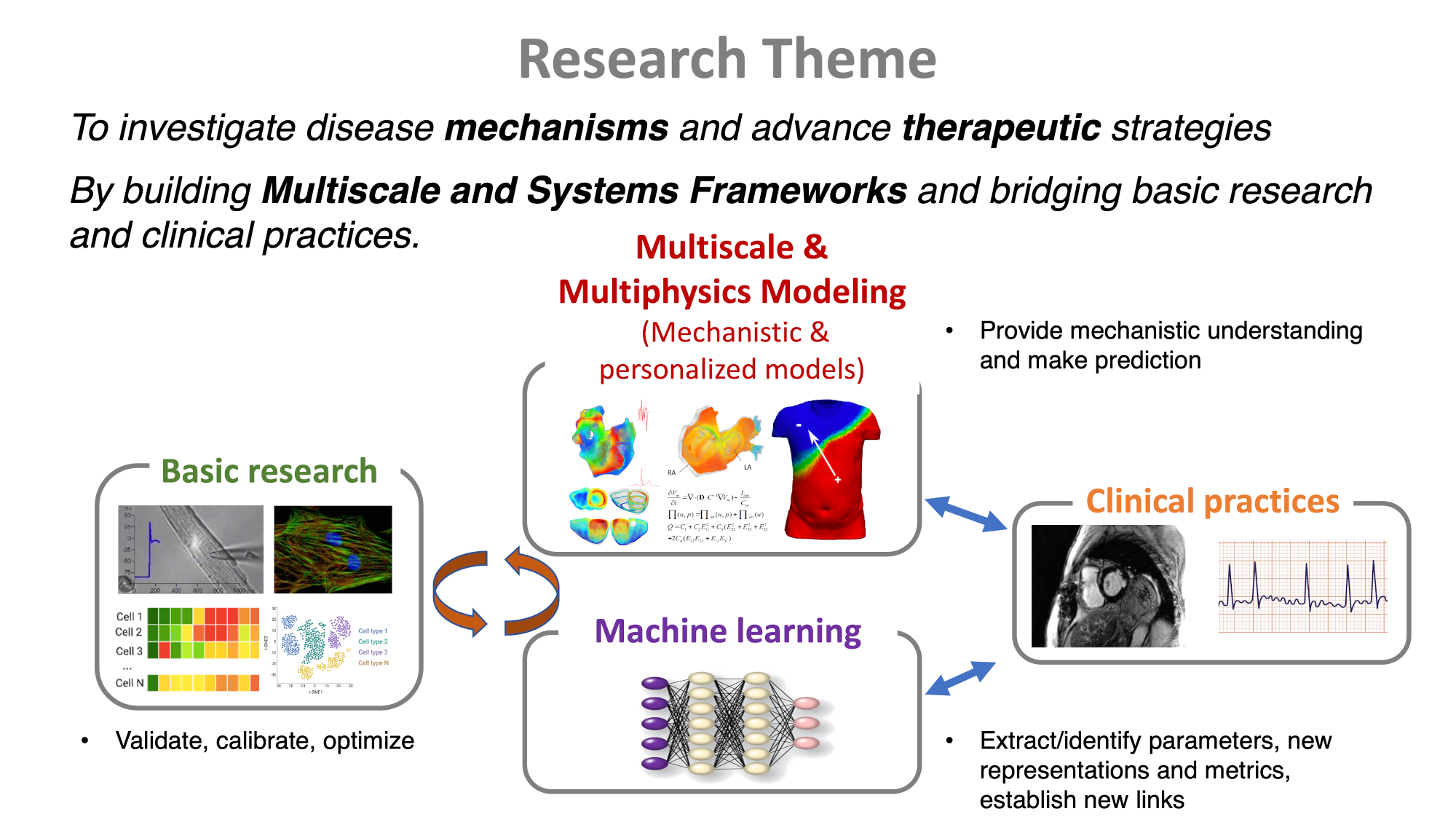
Our research themes — from ion channels to patient-specific digital twins of the heart.
Mission
We build digital twins of the human heart — biophysically detailed, anatomically realistic, and patient-specific computational models — and use them to understand and treat cardiac arrhythmias.
Our goal is to bring to medicine the level of predictive impact that computational modeling has long had in engineering.
Research Areas
Our ongoing research integrates mechanistic modeling, multi-scale simulation, machine learning, imaging, and clinical data across the following areas:
-
Digital twins for atrial fibrillation
Developing patient-specific atrial models to study arrhythmia mechanisms, identify sustaining substrates, and support personalized ablation and rhythm-control strategies. -
Digital twins for heart failure
Building multi-scale models of the failing heart to connect remodeling, electrophysiology, mechanics, and clinical phenotypes, with the goal of improving mechanistic understanding and therapeutic planning. -
Multi-organ digital twins and crosstalk
Extending cardiac digital twins toward integrated heart-kidney and broader multi-organ systems to study physiological coupling, disease interactions, and treatment response across organs. -
Digital cells with hybrid AI, LLM-based, and mechanistic ODE-based modeling
Creating data-informed digital cell models that combine mechanistic ordinary differential equation frameworks with AI components, including LLM-based modeling, to improve calibration, prediction, and biological interpretability. -
AI-powered digital twin surrogate modeling
Developing fast surrogate models and reduced-order learning frameworks that accelerate large-scale simulation, uncertainty analysis, and virtual cohort studies while preserving mechanistic fidelity. -
Medical informatics for cardiovascular disease
Using structured and unstructured clinical data to study cardiovascular disease, support risk stratification, and connect computational models with real-world patient trajectories. -
Intelligent medical image processing
Designing AI-enabled pipelines for cardiac and related medical imaging, including segmentation, reconstruction, quantitative phenotyping, and model-ready image processing for digital twin construction.
Approach
Our work spans:
- Multi-scale, multi-physics modeling of cardiac electrophysiology and electromechanics, from ion channels to the whole organ
- Patient-specific digital twins constructed from CT/MRI imaging and clinical data for virtual trials and personalized therapy planning
- AI-enabled computational medicine, making complex simulation more efficient and clinically actionable
- Mechanistic investigation of arrhythmogenesis, drug response, and cardiotoxicity
Who We Welcome
We welcome trainees and collaborators from diverse backgrounds, including:
- Computer science, electronic and information engineering, biomedical engineering
- Physics, applied mathematics, and mechanical engineering
- Physiology, pharmacology, cardiology, and related life-science disciplines
- Clinical medicine
We recruit at multiple levels, including postdoctoral fellows, Ph.D. and master’s students, research assistants, visiting students, and undergraduates. For current positions, please see Openings.